Showing posts with label Election. Show all posts

Monday, May 13, 2013

Rajya Sabha elections in TN:political realignments?


 In a situation where only the ruling AIADMK has the numbers to send its nominees to the Rajya Sabha, CPI leader A.B. Bardhan is seeking an appointment with Chief Minister Jayalalithaa to try and get her support for his party candidate. The meeting is likely to take place on May 20 and this could be a beginning of a political realignment in Tamil Nadu.
 V. Maitreyan and A. Elavarasan (AIADMK), Kanimozhi and Tiruchi N. Siva (DMK),  B.S. Gnanadesikan (Congress) and D. Raja of the CPI are now retiring after a six-year term, and the seats are up for grabs.  Mr. Raja and Dr. Maitreyan emerged as the face of their parties in Delhi.
 A candidate needs 34 votes to find his or her way to the Upper House. In such a situation,  the ruling AIADMK, with a strength of 151 members [including the Speaker] in the Assembly, can send as many as four to the Upper House, but no other party in the State has the numbers required to get their candidates elected on their ownInevitably, intense jockeying has begun for the remaining two seats at stake. Mr. Bardhan is expected to solicit her party’s surplus votes for D. Raja who could seek re-election.
 The Left parties together have 18 seats — CPI (M) 10 and the CPI 8 — in the Tamil Nadu Assembly. Sources in the Left said that CPI (M) general secretary Prakash Karat had committed his party’s support to the CPI candidate and the CPI candidate’s fate was in the hands of Chief Minister Jayalalithaa.
 “Since Ms. Jayalalithaa is talking about creating a non-Congress and non-BJP front, we could work together. When he meets her, Mr. Bardhan is likely to ask for her support in the RS polls,” said a senior CPI leader. If the deal works out, the AIADMK-CPI combine will win five seats. But it is not clear whether Dr. Maitreyan, who has completed two terms, would get yet another chance. A point in his favour could be that his first term in the Rajya Saba lasted only two and a half years.
 While the two DMK MPs are retiring, it can, at best, hope to get only one re-elected, but only with the support of some other party. The party has 23 members in the Assembly and is sending feelers to various camps including the main opposition in the Assembly Desiya Murpokku Dravida Kazhagam (DMDK) which has 29 members. But five DMDK members are functioning as a pro-AIADMK bloc in the Assembly. The two parties could come to an agreement whereby the DMDK will support the DMK candidate now and, in turn, the DMK will accommodate the other in its front in the 2014 Lok Sabha polls.
 If any such agreement materialises, DMK patriarch M. Karunanidhi’s daughter Ms. Kanimozhi could be fielded again, it is said. If Jayalalithaa agrees to support the CPI which is backed by the CPI (M), the Left would remain with her despite the recent disenchantment of the CPI (M) with the AIADMK. And if the DMK and the DMDK strike a deal, that could be a precursor to the next year’s Lok Sabha polls.


Monday, March 4, 2013

North-East election result - a deeper analysis


Q. Is the Sangma magic over for good in Meghalaya?
A. Well, one Sangma succeeds another. PA Sangma took the voters for granted in Garo hills and the results reflect on their record and how the public view their work.
Q. How would you explain the utter lack of anti-incumbency in Nagaland and Tripura?
A. Tripura: People voted for peace and stability - as the Manik Sarkar government was seen as having ended the insurgency and moved modestly forward on infrastructure projects. Sustainability is the key here now. Also the Congress had no leader worth the name - the main crowd puller was a scion of the erstwhile royal family but he was given no official role or post. People can't trust a party which can't trust its own major campaigners. I doubt also if Rahul Gandhi's bombastic claim that the Congress would toss the CPI-M into the sea went down well: it boomeranged.
Q. Incumbents have been re-elected in all 3 states. in Meghalaya it may be due to fractured opposition. But in Nagaland and Tripura has congress become so in-effective?
A. Congress in Nagaland had four contenders for the job, they did not present a united front (sic) and lacked conviction; in addition, in Tripura, as I have said in an earlier post, they had no leader worth the name who could match the CPI-M track record or its consistency. People nowadays are rarely swayed by public oratory or major promises: they judge parties and candidates on the basis of elections. IN many ways, national parties like Congress and BJP become regional parties in such contests with local issues, image, community support and party mobilization as much as performance dominating and influencing votes.
Q. If the Megahalaya like trend continues at national level where the fight is congress vs the rest, incumbent may hit a hatrick in 2014?
A. There are a significant number of states under the control of non-Congress and non-BJP parties. From east to west, north to south, this is the story -- Samajwadi Party, Akali Dal, AIADMK, BJD, NPF etc. These would have a great influence on the 2014 results, its too early to call though I would wager that the Congress would lose a number of the seats it is holding.
Q. What does North-East poll results mean for Congress?
A. That they don't have any local leaders of any substance and stature in most of the states of the region and that this bodes ill for the part in the 2014 elections for the Lok Sabha as they need to find winning candidates. Also that young members of First Families at the central or local levels may not swing the state elections if they have nothing to show for a track record, either by working in a public office or working in the state. So called charisma and family connections don't work beyond a point: people want their problems understood and resolved as all elections are becoming more and more 'local'.
Q. What is the message from Electorate?
A. That media coverage doesn't mean that you've got the votes and that crown princes without a record of actually delivering on promises and holding public office can draw crowds without winning their confidence or votes
Q. Which politicians corrupt more in Meghalaya, Garos or Khasis?
A. All parties.
Q. Can these results have an impact on the polls in Assam?
A. The Assam state elections are still nearly four years away. Issues like demands for peace so that people can live in security, farmers' rights, land alienation, lack of communal peace and basic governance -- health, education and delivery of services will count more.
Q. What impact will it have on Lok Sabha election next year?
A. As I've said earlier, it stresses a growing trend -- that regional parties and non-'national'parties like Samajwadi, BSP, DMK, AIADMK etc will have major roles in the next elections. Question will be who will they align with or which of the big parties will tie up with them. Also that all elections are increasingly becoming local with local issues and leaders pulling votes and crowds.
Q. BJP opens its account in Nagaland by winning one assembly seat. Your views.
A. In Nagaland and other Hill states of NE, they will be one-seat party! Better to invest those huge funds elsewhere where they are taken more seriously as where they have an understanding of basic issues.
Q. Is the Congress defeat next year in Nagaland and Tripura inevitable?
Yes.
Q. Why Is Left wining in Tripura?
As I've said before, peace and security, stability and some development. Also a total lack of Congress leadership. in other states: 1. stability concern in Meghalaya and 2. in Nagaland a lack of public expectations from any party as well as a sense that Chief Minister Nephiu Rio can push the peace process and some development work forward. A pity that no woman candidate won in Nagaland though.
{from CNN-IBN channel}


Sunday, March 3, 2013

North East State Election


Incumbent parties have stormed back to power in the three northeastern states of Tripura, Nagaland and Meghalaya. In assembly election results the Left Front not only retained its last bastion Tripura, winning 50 of 60 seats, but did one better than in 2008. This was the fifth straight victory for the CPM and a huge vote of confidence for its chief minister Manik Sarkar, at the helm now since 1998.
In Nagaland, the Naga People’s Front (NPF), which promised to solve the vexed insurgency issue dogging the state since 1959, snapped up 38 of the 60 seats that went to polls on February 23. The Nagas gave a clear verdict to Neiphiu Rio, who will be heading the coalition along with the JD(U) and BJP – that won 1 seat each - for the third successive time. The Congress won just eight seats here.
Meanwhile in Meghalaya, the Congress, led by the youthful Mukul Sangma, managed to bag 29 out of 60 seats even as speculations were rife that the party would ‘discard’ its regional allies and form the government with independents, a large bloc with 13 MLAs. It also marked the worst defeat for ex-Lok Sabha speaker PA Sangma. His National People’s Party won just two seats. In 2008, when PA Sangma was still with the NCP – he broke away after the presidential elections last year – he had won from 11 constituencies. This time his younger son Conrad, who was also leader of opposition in the Meghalaya assembly, lost though elder brother James came through in Dadengre. Just two short of a majority, the Congress will look to ensnare a few of the 13 independent candidates. The other large bloc, United Democratic Party, has eight seats.

North-East Election Result - a deeper analysis

Monday, February 18, 2013

2013 Elections in India

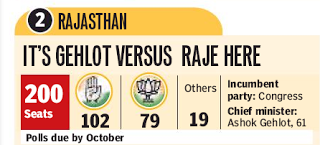
             Nearly 10 states will go to their Assembly elections in 2013. The first set being the North-Eastern States. Second set is Karnataka in Oct 2013 and by May 2013 important big states (semi-final for Lok Sabha elections) such as Madhya Pradesh, Rajasthan and Delhi goes to the polls.


Friday, February 15, 2013

93% of votes polled in Tripura Assembly Election


93% of votes polled in Tripura Assembly Election.
Tripura set a new record for the country's highest-ever vote turnout with 93% polling in the Assembly Elections. In 2008 Assembly elections, Tripura set a record of 91.22% of polling, which was so far highest in the country.
The real lover of democracy (Election held on Feb 14, 2013; Tripura people turned to show their love for democracy is something to be highlighted by media; but none of the Indian stupid media done this)

The highest turnout of 96% was recorded in the reserved tribal constituency of Raima Valley. Dhanpur reported about 95% turnout.
Tripura is a state in North Eastern India (For Indian politicians and Indian Media, North Eastern is an unwanted one)
Total Assembly Seats: 60
Candidates in fray: 249
women candidates: 15
Current CM: Mr. Manik Sarkar (CPI-M) {the poorest CM in India}
TRIPURA IN INDIA
The third-smallest state in the country, it covers 10,491 km2 (4,051 sq mi) and is bordered by Bangladesh to the north, south, and west; the Indian states of Assam and Mizoram lie to its east. Five mountain ranges run north to south, with intervening valleys, while to the west Agartala, the capital, is located on a plain.
Scheduled tribes, constitute about 30 per cent of the population. The Kokborok-speaking Tripuri people form the major group among 19 tribes and many other subtribes; Bengali people form the ethno-linguistic majority. Mainstream Indian cultural elements, especially from Bengali culture, coexist with traditional practices of the ethnic groups, such as various dances to celebrate religious occasions, weddings and festivities; the worship of regional deities; and the use of locally-crafted musical instruments.
Tripura is a landlocked state in North East India, where the seven contiguous states—Arunachal Pradesh, Assam, Manipur, Meghalaya, Mizoram, Nagaland and Tripura—are collectively known as the Seven Sister States. Tripura sends two representatives to the Lok Sabha (the lower house of the parliament of India) and one representative to the Rajya Sabha (parliament's upper house).
The main political parties are the Left Front and the Indian National Congress. Until 1977, the state was governed by the Indian National Congress. The Left Front was in power from 1978 to 1988, and then again from 1993 onwards. During 1988–1993, the Congress and Tripura Upajati Juba Samiti were in a ruling coalition. In the last elections held on 23 February 2008, the Left Front won 49 out of 60 seats in the Assembly, 46 of which went to the Communist Party of India (Marxist). Tripura is one of only three states in India (the others being West Bengal and Kerala) where the communist party won elections to hold power.Communism in the state had its beginnings in the pre-independence era, inspired by freedom struggle activities in Bengal, and culminating in regional parties with communist leanings. It capitalised on the tribal dissatisfaction with the mainstream rulers, and has been noted for connection with the "sub-national or ethnic searches for identity".
The Tripura elections are crucial as results will decide the future of the Left Front in the country.